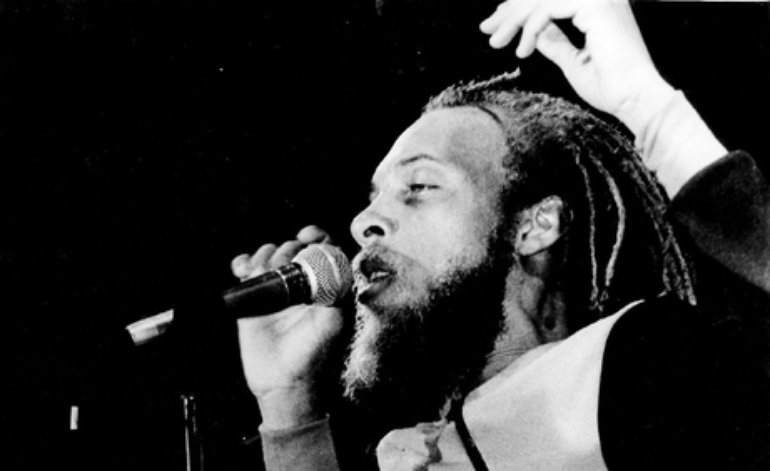







Abiodun Oyewole is a founding member of the Last Poets, a collective of African-American poet/musicians dating back to the 1960s, with a focus on civil rights and Black nationalism. As of 2025, with the group's current lineup, Oyewole is a kind of father figure in the group. The Last Poets’ new release, Africanism, is a remarkable collaboration with the late Nigerian Afrobeat drummer Tony Allen. The album was created from tracks Allen recorded at Prince Fatty’s Brighton studio in readiness for the Poets’ next album. The poems presented on the album are classics from the Poet’s repertoire, all reimagined in the indelible spirit of Afrobeat.
Since the Last Poets officially formed at a Harlem event in 1968, honoring the birthday of Malcolm X. The Poets’ devotion to combining spoken word with music has led many to contend that they are the true grandfathers of hip-hop. But, as Oyewole told The Guardian, "People say we started rap and hip-hop, but what we really got going is poetry."
Oyewole has a lot more to say about the group’s work. Afropop’s Banning Eyre spoke with Oyewole over Zoom for a wide-ranging conversation. Here it is, lightly edited for “flow.”
Note that the YouTube clips in this article come from Africanisms. You can also find the original versions of all these poems on YouTube.

Banning Eyre: Abiodun. Thanks very much for doing this. I appreciate it.
Abiodun Oyewole: Thank you.
I've been familiar with your your doings over the years and I was particularly excited by this album because Tony Allen is one of our heroes. Afropop had a lot of experiences with him over the years. and it's terrific to hear your work with his unique vibe.
Yeah, I was hearing some of the tracks myself and I particularly appreciated the connection. It was a nice marriage between what we were saying and the music. And I didn't know how it was really going to work, because in the beginning we just had the conga drum. But to take it to the level of Afrobeat, Tony Allen was the person I think to do this the right way, because he's got skills. There's no doubt about that.
Yes. He’s very subtle, and the groove is deep.
“Two Little Boys” really knocked me out. That was one of the special tracks. But, you know, he checked out recently, or passed away.
Yes. During COVID.
Oh, was it the virus? Yeah, my brother died from that too. My brother was somebody that didn't think a virus could take him out. My brother had invincibility. I think a lot of people thought, virus is not going to take me out. Other people might get it and suffer, but I'm not. And so my brother didn't put no mask on and he didn't get no vaccination. And he caught it. And once they put him on a ventilator, my sister said that that was the end, because the ventilator substitutes what your lungs are supposed to be doing. That's not your air. And if your lungs aren't functioning, the machine can’t function, so he checked out.
We lost a lot of great people during that time.
Yeah, we did. We really lost a lot of people. And the Taco Man didn't even have enough to go on TV and express condolences for all those people. I think about a million people in America died from that thing.
We didn't have to lose so many. Let me ask, let me ask you about Fela Kuti. When did you first become aware of Fela?
I became aware of Fela before they did that play here in New York City. Before that, I had heard about him from some of my friends who had been visiting West Africa. This one brother told me, he said, “Man, he's a big fan of you guys. He’s a fan of you and James Brown.” And then there's a place here in Harlem called The Shrine.
I know it well. Great club.
They kind of reproduce what Fela had in his place with the albums and stuff like that. It's a nice spot and I've been there a number of times. I've performed there a number of times as well. I really appreciate the spot because it's very friendly. It's got a nice energy to it.
I went to see the play about Fela. They did a great job and they had albums in the theater, the different albums that had influenced his music. I'm sitting in a seat that's maybe a couple of seats away from my album that's on one of the pillars. And this young lady, she turns around and says, I'm sitting right next to your album. I said, “Don't look at me. Look at the stage.”
But I really enjoyed the play. Somebody in the cast knew I was there and they came and said, “We would like for you to speak to the cast.” So I went back and I spoke to the cast, There were some beautiful sisters in that play. My God, that was a part of Fela's thing. He loved beautiful women. But Fela’s music, it just grabbed me because it's full of life. I know some of the stories about the pieces he did when he said the police were coming and he was smoking some weed and he swallowed the weed and then they made him go in and take a crap.
Yes. That’s the story of his song “Expensive Shit.” Unbelievable.
I mean I've heard so many beautiful stories about Fela, but to think what blew me away was the fact that he was a man of the people and the people loved him. I mean he was a prince in his own community. But you know, I always say that even though we're all going to have to check out, it's the work that you leave behind that keeps you here forever. And so he's an immortal for sure.
For sure. He’s actually bigger now than he ever was in life. There is an excellent 12-part podcast about him out now. Fela: Fear No Man. Check it out if you can. I've known about Fela forever, read the books, interviewed his sons, seen the Broadway show and all that. But I’m learning a lot from this podcast. Very thorough and well done.

Here’s a question. We’ve been involved with presenting African music since the ‘80s and ‘90s, and I remember how artists would come from Africa and be really surprised that the audience was almost completely white. They would ask, “Where are our brothers and sisters?” Over the years, there's been a lot of discussion about why that was. There is a moment in this Fela podcast when Questlove says this interesting thing. He says, “When I heard Fela, I thought, ‘Wow! Finally some African music that's not so damn happy.”
(laughter)
So this relates to my theory about why it's been difficult for African-Americans to cop to modern African music. Most of the music that came here last century emerged out of the independence movements that culminated in the ‘60s. It’s music of celebration, all about uplifting ancestral traditions that were sidelined during colonial rule. And it is happy, just like Questlove says. Music like Fela’s is more aligned with the the spirit of African-American music, which is more about resistance and solidarity in the face of oppression. Emotionally, one is insider music and the other is outsider music. Does that make any sense to you?
Yeah, you know what? It makes a lot of sense to me, especially when you talked about how our white people have been enamored by the music. Just before the COVID virus, I was a part of a cultural exchange team, actually funded by the American Embassy, and I was the only Black male poet in the crew. There was a female poet, and then we had a Japanese woman that dealt with origami, but the person that was in charge was a guy named Tony Vacca.
Of course. I know Tony.
Tony Vacca plays the marimba, and Derek Jordan played the violin, and I've watched these guys in Senegal. First of all, Tony Vacca speaks Wolof better than I will ever speak Wolof. And I watched these two white guys on stage in front of 5,000 Senegalese, and blow them away. And so what I've discovered in Africa, and it's so weird—is that they have much more of a human connection than America. America has been so damaged with this whole racist concept. Africa doesn't see the race as much as they see the humanity. And I appreciate that. I looked forward every December because I knew I was going to be with Tony and Derek and we were going to be in Senegal for seven years in a row.
You went to Senegal seven years in a row.
Yes, man. The reason that the embassy was involved was because they had been funding the Hip-Hop Academy. I mean, hip-hop came from the Bronx, but they didn't get no funding from the government. But you see, America always wants to have its cause. So they use hip-hop because hip-hop is a big thing in Africa. So they have this Hip-Hop Academy. They get something like $50,000 a year to keep it going. We had one of the top singing groups in Senegal Bideew Bou Bess sponsor us, and the love and the energy!
But then somebody was saying to me, “Who you go to Africa with?” I said, “I'm with some white folks who understand.” And Tony would make it clear. He says, “Africa is the mother of all of us. Everybody comes from Africa, so I'm just coming back home too.” And when you discover that, it erases a lot of the BS that we go through here in America. Because America is small-minded in terms of this racist thing. It’s some basic insecurity as far as I'm concerned.
I've always liked people. I don't even know who you are, but if you can be a people person, we can hang out. It's about recognizing that. But we have cut our whole possibilities short by listening to stuff that is toxic. I discovered that when I was listening to Youssou N’Dour in Central Park, and all the white people were singing right along with Youssou N’Dour. They knew every single word; that freaked me out. It was hot as hell, about 85 and 90 degrees that day. And he had a jacket. He never took off his jacket. I said, “God damn, who is this guy?” The place was packed with a bunch of white folks who understood and loved his music. And so I realized, everybody is not a member of the Klan.
A lot of times, Black folks have a narrow concept of what humanity represents. And that's primarily because all of us have been stupid with this madness that we face here in America. Music is one thing that crosses boundaries, man. And it stops a lot of madness. I'm so proud and pleased that I know I have a musical community that covers everything and every aspect of life. And it just makes me feel like I always told the real truth. There's only one race on this planet; that's the human race.
I love that you have that connection with Senegal. It's such a great country, so musically rich.
You got to see the video I did in Gorée.
Pelorinho was the name of a place in Brazil where they actually were trying to make us slaves. I remember when Tony told me, because when we go to Senegal, we say in a place called Sobo Bade, and it's a beautiful retreat. You just go there and it's like you were in paradise for a moment. It's just special. So while we were at Sobo Bade, he said to me, “Next Thursday, we have a trip to Gorée. I was thinking we could possibly do ‘Pelorinho.’”
“’Pellegrino?” I said, “Wait, Tony, hold it. Today is Monday and you're telling me that Thursday we're gonna go to Gorée and you want me to do ‘Pelorinho’?” He says, “Abiodun, you're the last poet. I know you can memorize this stuff.” I said, “Tony, that is so cold.” He said, “Man, that's what we're gonna do. It makes no sense to do anything else. ‘Pelorinho’ is the perfect piece to do at Gorée.”
So I used my own scheme that I use in college. I had the poem, and I said it to myself before I went to sleep, and put the poem under my pillow. I did that for all of my schoolwork. If I had a test, I would read the passage or I knew it was gonna be on the test and put it under my pillow. I guess through osmosis or something, it gets in there.
That's fabulous.
You know, it's just a trick. Everybody's got their little ways of memorizing stuff. I did this for all my videos, and I've got quite a few, but that's my favorite. It's a very, very special video of “Pelorinho” with Bideew Bou Bess singing in the background. It’s a beautiful thing.

I’m curious about your name. I read that you were given that name when you were 15 years old in a Yoruba temple. Tell me that story.
Well, you know, I went to Haaren High School in midtown Manhattan, so 59th and 10th Avenue. Haaren High School doesn't exist anymore. That building is now John Jay College. But I'm sure it was one of the oldest schools in the city. It was an all-boys school. I went to an all-boys school because I like girls, and I knew if I went to a school with girls, I was never going to graduate.
You wouldn’t learn anything.
Right. Because girls could be a big distraction, especially for a teenager, you know, at that time. Hormones. But I had a great time in high school. On half days, when your parents don't know, that's free time. So I had a half day, and my friend and I, we'd always go to one or two places, because I was raised in Queens. We’d go to the village to see all the beatniks and all the freaks. Or we go to Harlem, because that was a unique place; Harlem always has so many exciting things to see.
So me and my friend Leon, we went to Harlem, and we came across this African-looking edifice on Lennox Avenue and 119th Street. The only thing I knew about Africa was from watching Tarzan movies. And so I knew some of the boys that would taunt, “Buwanna, Buwanna, Ugabugga.” So I'm standing in front of the building. And I'm saying “Buwanna, Buwanna.” I'm just acting a fool, just being silly. Then this light skinned guy, dressed in full African garb, comes out and he says, “Why don't you come inside and see something adventurous?”
And I'm looking at him, thinking to myself, “He can't be African. He's too light to be African.” You know, because I'm thinking, Africans are real chocolate, Black. So I go inside and there's all these masks and all this weird stuff. It was just kind of strange. But I'm curious. He gives me a black [indecipherable], and he gives me a white chalky [indecipherable], and he says, “Shake and separate.” So I shook and separated. Then he points to my hand. “Just open it up. Let me see what you got.” And after he finished, he says, “Well, your name is Abiodun Oyewole.”
I said, “No, it's not. My name is Charles Franklin Davis. In fact, my friends call me Chucky. They call me Lucky Chucky.” He says, “That's your slave name.” I said, “I'm not a slave. What are you talking about?” He says, “You got to understand this. the slave masters made us take on English names. I'm telling you what your name was before that experience.”
I couldn't believe it. This is the first time I heard anything remotely close to this. I'm 15 years old. Plus, I was known, I was a leader, I was Chucky. I was a guy that made a jump shot to win a basketball game. I mean I had all kinds of accolades. I wasn't trying to change my name. So I didn't buy none of it, but what he did, he says, “Well I'm gonna write it down. Abiodun is a name given to a child born on a festival occasion, and Oyewole means ‘good fortune follows me.’” He says, “If you decide to use it, here's the information about it.” So I took the piece of paper and I put it in my wallet, but I wasn't thinking about it; it just sounded weird to me. But then, when I was about 17, and I was with some of my friends in Harlem and we heard this guy making a speech and he says, “Yeah. You all sit out there with your American names, proud to be called by your master's name.” He was just coming down on everybody, and I told my boys, I said, “I ain't got no American name, I got an African name. When we say Chuck is coming, we talk about a white person. My name is not Chuck. If you don't call me Abiodun, I'm not going to answer you.”
You owned it.
I owned it, and then took it a step further. I ran into my mother at the bus stop in Queens, and I said, “Mommy, I’ve changed my name”. She said, “What's wrong with you?” I said, “I changed my name to Abiodun.” She said, “I gave you your grandfather's name. It was a perfect name. What's your problem? You lose your mind?” I said, “Mommy, my grandfather didn't know, and you didn't know. I'm taking back things that were taken from us.” She did not understand it. And now if you talk to my mother—my mother's 99 years old—she says my name better than I say it. She has nothing but respect.
But I tell people the lesson that I got from that whole thing was, if you adopt something that is different than what people are used to, you can become what you have adopted, and then they can get on board. But if you're still the same person, they're not gonna change either. They're gonna see you as the old character. I did evolve into another human being, and that's why my name is meaningful now, because I am now truly Abiodun. There's no doubt.

I love that story. I was reading some of your interviews, and there was one quote that stuck out. You said that your goal was “to pull people out of the rubble of their lives.” Do you remember saying that?
I don't remember saying that.
Well, does it sound like something you'd say?
Listen. I got a quote one time from a young lady, a good friend of mine, a known poet, Aja Monet, great poet. A young man at Odyssey House had me there as a guest at the Nuyorican Poetry Cafe and brought me on stage and Aja told people I had said, “If you want to see how ugly the world is, create something beautiful.” And I don't remember saying that. So when I walked up on stage and I hugged Aja and said, “Why do you say I said that?” She said, “You did say that. I can tell you when you said it, and I knew you were going to deny it.” But you know what? When you are talking and you're trying to express yourself, a lot of things may come out, and I can't remember everything I've said, but I'm just trying to communicate a point. And sometimes things fly out of my mouth that I'm not even aware of. So that line I'm not familiar with.
Got it. One of the themes that seems to emerge a lot in conversations about the Last Poets is the duality of poetry vs. rap. You guys are often presented as the origins of hip-hop. I gather that you don’t buy that characterization. So I wonder. How would you describe the difference between poetry and rap?
You know, rap is really poetry with a beat, and the beat becomes more predominant in rap. If you're really a great rapper, you've got to be a poet. When I look at people like Rakim, I appreciate his work because he's a poet. I was with my kids this past March at Columbia, and they were discussing the different rappers. They didn't even put Tupac into the category of a rapper. They said he was a poet, and it makes sense because he did come up with a book of poetry before he ever became known as a rapper. I met Tupac and I knew his mother as well as his aunt Assata.
But rap comes from poetry. Basically it has poetic nuance. The main thing is that poetry must deal with figurative language, and rappers do too. Rappers, most rappers, are going to use the hell out of alliteration because they want to get that flow. And so that's happening. Metaphors and all that stuff will be used as well. But the poet is not concentrating on the beat. He's concentrating on the message of what he's saying primarily. Rap is really caught up with the swag of the rhythm of what they're saying.
Nelly Nell is another rapper who is very poetic. I mean I always consider, “Don't push me because I'm close to the edge; I'm just about to lose my head.” That's poetic to the max. Nelly Nell has participated with the Last Poets on a couple of our albums, Holy Terror. He gave us nothing but poetic love and I appreciate him. KRS is also another poet rapper, but for the most part, rap is dealing with the beat more than with the substance in terms of what they're saying. I mean you can get away with saying bubblegum and bullshit in rap. You can't get away with doing that in poetry.
And that brings us to the album with the Tony Allen. Correct me if I'm wrong, but most, maybe all, of these poems pre-existed. You've recorded in other ways and now you're doing a new interpretation of them, one that has a lot of beat in it obviously, because you’ve got Tony Allen bubbling away there.

Old money, new bottles.
Absolutely. I gather that Tony recorded these tracks in 2019, and then you made the album later. How did you go about picking the right poems to go with those beats? What was that process like?
My whole thing is it's about feeling. In a way I'm taking a page out of the book of our original conga player, Nilaja (Obabi). If you had a poem for example that you wanted to be in the repertoire of the Last Poets’ program, you have to get on stage and read your poem in front of Nilaja, our percussionist, in order to get approval that you're going to put this in the program. Now Nilaja, I'm sure he did not know anything at all about metaphors or similes or none of that stuff, but I can tell you this, if Nilaja did not pull that conga drum out of the duffle bag and play while you were on stage, you might as well throw that poem in the garbage.
I'm gonna tell you something. That was critical, because one time it happened to me and I was upset. I was hurt, because I had written what I thought was a great poem called “Get Hip.” I was coming down on all those bourgeoisie Black folks in Queens, and I was ranting and raving and just scolding them and Nilaja never even looked at his drum. Not one time. That stayed in the bag. And after I finished, (Gylan) Kane said, “Man we're not reading that crap on stage, all that raving about people. That's where you are; that's where you were from; that's who you are.” And I had typed it up using my grandfather's remaining typewriter. I typed up two pages of garbage and it really hurt because you're sitting writing something and it's so much but it's no good. That's a personal afront, you know?
So I had to go back look at that piece and I realized what it was. But Nilaja, by the same token, when I did “Two Little Boys,” it was a different story. I'd seen that take place in Sylvia's Restaurant. These little junkie kids come in and eat and I knew that they were up to no good and then they dashed out without paying. I felt bad because Sylvia's Restaurant at that time… she just had one little place and she was struggling. I thought it was wrong for them to come and eat for free and not pay. So I ran after them and I had one of them by the collar and she made me let go. She said, “Let them go. Two junkie babies. I'm just glad they got something to eat.” And when she said that it touched me so much, I had to write this down. So I wrote a poem in the place about that incident and when I shared it with the group Nilaja couldn't get the conga drum out of the duffle bag fast enough. All he could do was get the top available for his hands and he started communicating with me right away. And it was like a conversation. I would say a line and he would repeat it because he was feeling it.
So the feeling is the same way. I'm just saying all I have to say that when I heard Tony, when I heard the music, I was feeling that would go with what was happening. It was strictly a feeling thing.
You know, when I teach creative writing, I say we have five senses and if you're a poet you've got to affect at least one of my senses: sight, touch, taste, smell, sound and feeling. And the feeling piece is vital because if I can't feel you, chances are it's not going to penetrate. And I could feel Tony's music. I mean I felt I could hear certain pieces that I had that would fit what he was saying musically. Because music has its own language. You know I always refer to a lot of our jazz artists as poets. I said they're poets but they're poets in sound. They're not writing poems like Langston Hughes or myself, but John Coltrane, when he came up with the song “Naima,” I could see Naima. I mean it was clear. The poetry is in the sound and that's what makes that song universal. I used to actually use jazz compositions in my workshops. I’d say, “I want you to listen to ‘Round Midnight’ by Thelonious Monk and I want you to tell me what he's saying musically. I want you to write down verbally what you think he's doing musically. I come up with some wonderful poems, because the poetry is there in the music. And so that's what I heard when I was listening to Tony Allen's stuff.
I think of Afrobeat, because I know where it's coming from. I know that James Brown's influence is there. And God, if you can't go up with James Brown, you don't understand the nature of funk. Just like Bootsy Collins. Bootsy Collins played behind us on Holy Terror. And I was really happy to meet Bootsy and to have one of the funk masters play with the Last Post, and then I found out that Bootsy Collins is from the same city. He's from Cincinnati, Ohio. I'm from Cincinnati, and that's where he's from.
Nice. What about the track “This is Madness,’ where you say, “All my dreams have turned into psychedelic nightmares.” That's a line that sticks with me.
That's a classic piece, that's Umar Bin Hassan. Umar is an interesting character. I put Umar into the group. The original group was myself, David Nelson and Gylan Kane. Then the group went through some changes. The first person to leave ironically was David, because it was David's idea to start the Last Poets. We put Felipe Luciano into the group, so for a moment it was Gylan, Felipe and myself. And then Felipe went and did an organization called the Young Lords, which is like a Puerto Rican Black Panther organization in Spanish Harlem.
Kane went down to the village and he had a thing called the Blue Gorilla. He was doing his own individual thing and he was doing some acting. And I was left as the last Last Poet. This was before any recordings or anything. But I didn't want to ride as a lone ranger, so this guy named Umar had come from Akron. We had performed in Ohio, and he was smitten by us and he came wanting to join the group. We weren't recruiting, but his timing was perfect because we were kind of breaking up.
So Umar got into the group and I got him a place to stay. I had a gig at the place he was staying. He was staying in a dormitory that was for college students. He wasn't in college but I knew the sister in charge and I got him a place to stay in that spot. I had a nice thing going on with the young folks. They had respect for me and they knew my work. And I told them, there's a guy here who wants to be in the group but I've never heard any of his poetry and I'm going to let him do something today and you’re going to let me know if you think he could be in the group.
Well, he had two poems and they both were garbage, but his delivery was different. His voice was like a trumpet and he'd take you on highs and lows. It was very musical. I heard the talent in his delivery but I told him that the poem that he had done, you could never do it on stage because it was garbage. It was called “The Motherfucker Poem,” and it was horrible. It didn't have any poetic nothing to it. The only thing he kept on saying was so and so was a bad motherfucker. But I took that energy and I said we can make him into a poet. So I worked with him and got him to write. He wrote one of our classics, “Niggers Are Scared of Revolution.”
Yes. I wanted to ask about that one. Quite the provocative title.
That's the poem that I got because I told him, “Listen, Umar, all your poems are short. You don't give people time enough to get into them. You got to write something that's going to link to it. And you got to get into it.” We were getting ready to do an album. I said, “Listen, I'm bringing you over here to Mount Morris Park.” It's been changed now to Marcus Garvey Park. I said, “I'm going to sit you on my rock. This is a special rock. You've been in Harlem for about three weeks. I know you must know something about niggas since you've been here.” He says, “Yeah. Niggas scared of revolution.” I said, “Write that down, write that down and tell me all the ways that they afraid of revolution.”
I said, “I got errands, but you're in a good spot. I'm going to come back and I'll check your stuff.” Man, I came back and he had written a masterpiece and I was blown away. And do you know that that man has not written a short poem since then. Everything he writes is long.
And of course, “This is Madness.” This is his piece. Unfortunately, Umar is suffering from dementia. He can't remember anything that he's done. I feel badly. But he damaged himself with drugs when he was younger and that doesn't go away. It causes damage that sometimes you can't change up. But the fact is that his work is immortal and he's left a legacy. But “This is Madness” was a classic piece, and I look at what's happening right now. That poem is extremely apropos to the moment right now. This is truly, truly madness.
Sure is. Thank you for that. The poem “New York, New York” is interesting. The groove on that one first of all reminds me of slower Afrobeat grooves. If you know the Fela song “Go Slow,” which is about being stuck in traffic in Lagos, it’s got a similar feel.
That one was written in ’68. That goes way back.
New York has gone through a lot of changes since then. Do you think this one still applies” Does the message of that song still still work for New York today?
There's a guy named Robert Anderson who did a movie called Windows on the World (2019). It was a story about a Mexican migrant coming here and working in the city to send money back to his family in Mexico. The father had come alone, and no one in the family had heard from him for a while. So they began to worry and the son actually goes to see about his father. So his father had become a window washer, and Robert wanted me to actually approach this window washer, and just do “New York, New York,” to give him insight as to what New York was all about. It was really funny because we were down on Mulberry Street, down in the village, and we had to do the piece about six or seven times because I didn’t understand what they're looking for. But I was really interested because when I did see the clip, I was thinking to myself, it’s really like I wrote that poem yesterday. I mean, the situation is still the same.
And the part that I remember that really stuck out was where I say, “Siren sounds through the street, putting your mind in a state of mental paralysis.” And those sounds are still here. Those sounds are very clear, and they're very disturbing; they could wake up the dead. And I said, “Wow, all the parts that are used in that poem, they still exist.” I mean, the names of the shoes might have changed, like Stacey Adams and Florsheim. I don't know if they still exist, but the concept and the theory behind it all is still there. I mean, New York is a state of mind.
That poem actually was the beginning of the end between the group breaking up because Kane, who was a military member… I considered him to be the best poet of the three of us. I was learning, I was the youngest, and Kane was an established poet. He's an excellent poet. And he had a poem called “New York.” But I remember one time we were doing a performance, and the guy in the audience yelled, “I want to hear ‘New York.’” So Kane thought that he wanted to have his poem, “New York.” So he sent it to the mic, and the guy said, “No, not yours.” And I said, “Oh, Lord, that's a problem.” And it was because Kane had an ego, and now I'm like a student of his, but the students want to hear what the student has to say as opposed to what the teacher's saying. And that began a real problem between Kane and me. But that particular piece got quoted a great deal because of the fact that I had that hook, “New York, New York, the Big Apple.”
Finally, let me ask you about “Gash Man.” It’s got a powerful message, probably not a real popular message in some circles I imagine. But tell me about about that one.
“Gash Man” came about because of a conversation I was having with the great late Amiri Baraka. Amiri Baraka was my mentor and any opportunity I had, I would be in Jersey under his feet just getting information, because he knew a lot of stuff. Plus people don't realize this; he had a nice sense of humor too. He was just a fun guy. And I knew his background. I knew he'd hung out with Alan Ginsberg and Ferlinghetti. He knew all those cats because he was in the village. He would tell me stories and I just enjoyed his presence.
So I was over there and we’re in my car, and I'm asking him questions because I'm trying to learn. I mean I was talking to all the older cats; they all had information. They understood the structure of Black civilization, and they would be quoting pages from books that I had never even heard of. So I'm trying to get information, because Amiri was just brilliant. I'm asking him something, I forget exactly what it was, but whatever it was, I'm listening to him and we're talking, but he's not looking at me. And I'm looking at his eyes and his eyes looking at a big-butt woman walking down Broad Street. And I said, “Man, you ain't no revolutionary poet; you're a gash man.” And he said, “Wow. That's creative. If you don't use it, I'm going to use that.”
He didn't even see it as an insult. He saw it as a creative expression. I say things, and sometimes I don't even know where it's coming from, but I was trying to get his attention. So then I decided to write this piece called “Gash Man” to explain what that's all about. Brothers are using their penis like it's a knife. They aren’t loving. They’re just gashing.
But let’s fast forward. I just came off of a cruise a month ago. And it was a beautiful cruise with some of the known R&B groups, Heat Wave, Earth Wind and Fire, the Isley Brothers, Evelyn Champagne King, Full Force. A lot of classic artists from back in the day. I'm walking around the boat and one of the guys comes up and says, “Don’t forget your alligator shoes.” That's the line in “Gash Man.” Wow, I said, that poem really stuck out because it was sensual. It had a certain energy to it that the others didn't have. It became a very popular piece, much more popular than I would imagine it being. But it's because of the subject I think that I was dealing with. And the fact that quite a few guys could recognize what I was saying when I referred to them as gash men, no experience necessary. I had so many people quoting me from that particular poem. And so it was a pleasant surprise really.
That's wonderful when your words last like that and they come back to you. I love what you were saying earlier about jazz being a language, because so much of the music that that I've been dealing with these all these years isn't in English and I don't usually understand the words. But you get such strong messages from the music, the beat, the sound of the language. Even if you don't understand it, you're listening to someone like Youssou N’Dour and you get a lot without knowing the words. But I think that's hard for a lot of Americans. It's been one of the reasons why African music has struggled to get into the mainstream.
You know it blows my mind that this is where we really have to say, is it racism that causes it? Because the only classical music America can claim is jazz. And the fact is that the same instruments that made Bach and Beethoven and Mozart and all those cats famous, the Black guys just took those same instruments and flipped the language. But they're the same instruments, the piano, the horns. I mean that's all European instruments. And we just took it and did the same thing we've done with the language. You have a group of folks that are creative, we're going to use our creativity to affect the change in whatever it is that we're dealing with.
We've done that with the language. There is no group of people who have flipped the word “bad” into being “wonderful.” All of a sudden bad becomes the best thing going. “Man that's a bad dude over there.” And here we took the music and I'm sure that when Rogers and Hammerstein did “My Favorite Things,” they had no idea that Train would take it to another place.
So true.
I mean, that's a nice little melody, and Train heard the melody and simply acted upon it. He worked with it; he found other avenues. And the thing about it is, if you go to Europe you see how much they revere jazz. You can hear jazz on the stations easily. We have very few stations where you can turn on a station to hear jazz. And I'm saying that's disgraceful.
I've talked to school principals. I say, “I know you don't want to see fighting in the school. I know you don't want to see kids acting up and acting stupid. Play jazz in the hall while they're changing class. Play jazz in the bathroom. Play jazz in the cafeteria. Don't tell them what they're listening to. Play it. I bet you'll see a change in the way they act.” And I've had one charter school principal do that, and she got back to me and says, “You were right.” Listen, we are affected by music. Hip-hop does not calm you down. Hip-hop will charge you up and it'll have you beating up somebody before the day is over. That's unfortunate, but that's what it does. It just gives you that boom, boom, boom. I said, so your heart is pumping. Jazz calms you down. Jazz is a cerebral music. It makes you think, it makes you feel and it puts you in a whole different frame of mind. I say we could use our music to raise our children better than what we're doing.
I love that. Speaking of jazz, you've got some great musicians on this album. Who is it that's playing sax on “Just Because”? Is that Courtney Pine? There's a great sax solo on there.
I don't know who that is, but I know on one of our albums, we had Pharoah Sanders play sax. That was special. Pharoah was a special artist. Well, he was a student of Train’s.
So do you still do your open-house poetry workshops on Sundays?
Well, there's a guy in upstate that's been helping me. His name is Paul Richmond, another white guy who is a dear friend, like a brother, and he actually produced an anthology of the workshops. Because before the pandemic came, I used to have people over my house every Sunday. We played basketball and then from basketball we segue into poetry. And some of my basketball buddies, they wrote poems as well. It was quite interesting. That's really how it started.
I teach at Columbia, so I have access to the facilities, but they said, you can only bring two guests. Why bring 15 guys over there? And we'd be playing ball, and one particular Sunday, this kid said to me, he says, “Yo man, I know who you are.” And I said, “Well, listen, I'm glad you know who I am, but right now, I'm interested in playing some basketball.”
He says, “Brother, we're getting ready to play poetry.”
“I don't want to hear any poetry right now.” I was a basketball fanatic. I loved it. It was my exercise, plus I got a shot. That's why when I see Stephen Curry shoot, I'm not impressed, because I got my long jump shot. So we played, and this guy was on my team. We won five games in a row, which is excellent, because that means we had a winning team that day. And so we're getting dressed and coming home, I said, well, let me hear your poem. He reached in his pocket to post the poem. It was ink on a page. The sweat had dissolved the poem. And I felt so bad, because I didn't listen to it when he had first arrived. So I felt responsible. And now the poem had disappeared. And he looked like he was ready to cry, because he really thought highly of this poem.
I said, “Did you write that poem?” He says, “Yeah, I wrote it.” I said, “Well, I'm gonna bring you to my house, and I'm gonna sit you at my desk. I'm gonna give you this magical pen and a piece of paper, and you're gonna rewrite that poem.” So when he was here, I cooked food. That was the first time I had people dealing with poetry. And from then, every Sunday, I would have poetry after basketball.
And some tremendous poets came out of my house. Some that are no longer with us. (Craig) muMs, for example, who was a great poet. He checked out. Jessica K. Moore. Saul Williams. I mean, a lot of known people who have moved on to do other things. And it's become a real big deal. And I see the value in it. It's a chance to congregate and for other poets to get together. And I give people feedback on what could improve their work and so forth.
People that have been here, they know what I mean when I say, “Why do you hit me in the face with a brick?” You tell me about you had met this girl and you enjoyed meeting her and she had perfume that “intoxicated your nose.” And then you went over to her house and had a “euphoric experience.” You hit me in the face with a brick. What house? And what is a “euphoric experience? Give me some of the experience. At least let me feel the sweat coming down your back or something.” I mean, the poem stopped flowing right then when he said, a “euphoric experience.” If you're not gonna put some lips and butt on euphoria, don't use it.
But when the pandemic came, I just figured, can't have nobody in your house. We got to be quarantined. My niece and my son said, “Pops, you can do this online. You can still have your open house and be safe from the virus.” So we started doing it online and it's been outrageous. I mean, I've got people from Nigeria, from Brazil, from all over involved with this open house thing. And then, and because it’s so effective and it’s every other Sunday. So I told Paul Richmond, I really want to do something special because the poems have been tremendous. I want to do an anthology. So we have a book, I just got copies last week. We have an anthology of my open house Sunday that I can sell to people. It's really beautiful. I feel very honored to be the one to help initiate this whole thing.

That's wonderful. Well, listen, thanks very much, man. It's a pleasure and an honor to speak with you. I really enjoyed this.
It was a pleasure talking to you, man. I can only really feel free enough to say the things I've said, if the person I'm talking to is cool, like you are.
Well, thank you.
So thank you for your demeanor and just for the way we had this conversation. Because anytime I get a chance to go back into my past and to talk about some of the things I've done, it gives me a refreshing course as to my life. And I think that we all need to have that legacy of catharsis of sorts. And I appreciate the opportunity for that. So thank you for having me by.
I enjoyed every minute. And do check out that Fela podcast. You'll love it. Let’s stay in touch. And thanks again.
You too, man. Take care.
Surviving members of The Last Poets are:
Dahveed (David) Nelson (co-founder)
Abiodun Oyewole (co-founder)
Felipe Luciano
Umar Bin Hassan
Baba “Don” Babatunde (percussion)
Newest TLP Legacy member- Sharrif Simmons
Members who have transitioned:
Gylan Cain (co-founder)
Nilaja Obabi
Jalal Nuriddin
Suliaman El Hadi

Related Audio Programs