





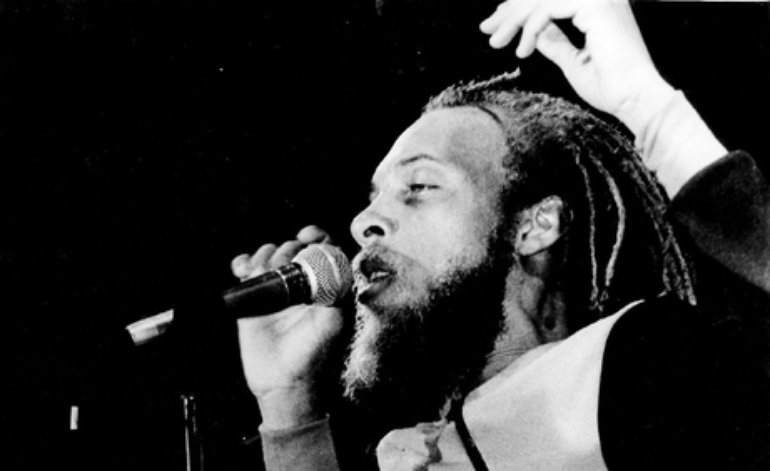
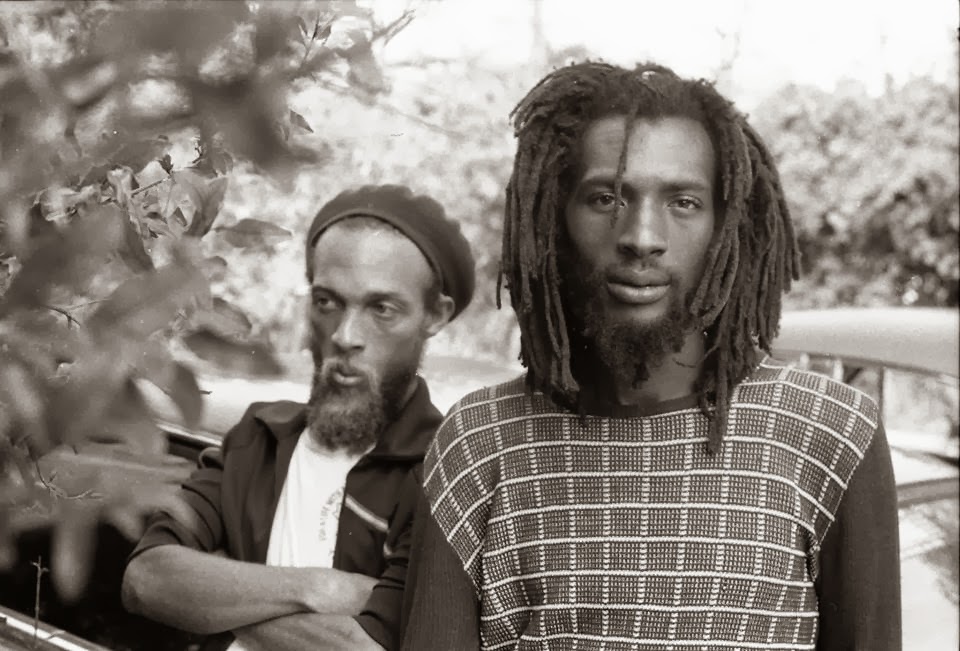
Afropop's David Katz and Saxon Baird interviewed Oku Onuora Feb. 10, 2015, in Jamaica, following Oku’s poetry reading at the University of the West Indies, Mona, as part of an event celebrating the life and work of noted poet and academic, Mervyn Morris.
Oku Onuora: My name is Oku Onuora, Jamaican poet, dub poet to be exact.
Tell us about the community you grew up in.
I was born in 1952 [and] I grew up in eastern Kingston, a place called Brown’s Town, in an area called Dunkirk, and it was a working-class community. There were very sharp lines between JLP and PNP, but during that time, there was a movement taking place, led by the Rastafarian movement, and it was anticolonial. And this came out of the whole environment that was taking place, the environment of the time where in the Caribbean, in the U.S., in Africa, there was anticolonial movement[s] taking place, there were former colonies [that] were striving for independence. So it was a very interesting period, where Jamaica, although a very small island, had influence because of the politics of the island. Rastafari added to that, the Black Power movement was at its peak at the time. So that’s how I grew up, that kind of climate, in the '60s. You had people like Walter Rodney, who had come to Jamaica at one time, and historically, the Jamaican people are very rebellious, and throughout the history of the Jamaican people we have seen this…like numerous rebellions and people even exporting the whole ideology of black consciousness, people like Marcus Garvey. We see Boukman [from Haiti], for example…even in Latin America, we see Simon Bolivar coming to Jamaica. So Jamaica has always been an influential place, and the struggle to topple apartheid in South Africa, Jamaica was there in charge, in the forefront, very vocal about the thing. So that’s the kind of climate I grew up in.
You said that in the area you grew up in, there was very strong division between JLP supports and PNP supporters. When were you aware of the division becoming so defined, and why do you think it was like that in your area?
Well, all right, one needs to remember that the mass[es], the people, working-class people are who really decide [who] the next party in power [will be]. They are the majority, and in order to secure votes, there’s a scramble to get as much votes as possible, so you find areas are divided along political lines, in terms of securing votes. And it was crucial. In fact, you had entire areas that were PNP or JLP. In fact, where I grew up in eastern Kingston, it was predominantly a PNP area. Michael Manley was the MP for the area that I grew up in, in east Kingston; in fact, it’s still a PNP stronghold, and on the border, down south, other areas like Rae Town and these places were strongly JLP, so there was a distinct[ion]. And that’s Kingston. Kingston’s a small place, it’s just like crossing the road [to enter another district], so there were sharp divisions.
So that was the case in the '60s, and still is the case now?
Yeah. That’s still the case, it has not changed. What has actually changed dramatically is that, prior to now, like in the 60s, the “Area Dons,” the strongmen, the enforcers, who were loyal to a particular political party, [they] were more controlled by the party. And after that, like the '80s, '90s, we saw a dramatic shift where these “Area Dons,” because of involvement in ganja, for example, in exportation of ganja, the migration to United States of America, in particular…because prior to that, you had migration mainly to the U.K., but then in the U.S., it took on a whole new different turn. But these people still kept their political alliance, because it gave them a secure base, but then they became more independent of the political representative of the area. So we see Tivoli Gardens, for example, we see other places, which are strongly aligned to a particular political party, but yet still, the people in control, the Dons, for example, don’t take talk from political representatives. They are more independent.
So there was a shift in the '80s, and part of that was because prominent enforcers had gone to America and gotten involved in the drug trade?
Most definitely. Not “because”—that is what took place. The enforcers, the trade, the illegal trade have managed to acquire wealth, and once they acquired wealth…there was a new breed also. They were savvy businessmen, and we see that, without calling any names, not any one particular name…from both sides, we see people who became wealthy businessmen who secured huge government contracts. So the whole landscape had changed, totally. It became more sophisticated, it became more international as opposed to being Jamaican, confined to Jamaica.
You say that the politicians no longer had the same control over the people they had built a relationship with, necessarily.
No, but, I mean, the people would still…because these strongmen, these Dons, still kept the alliance to the particular party, because of kickbacks and all them kind of thing there, loyalty. So therefore, they would ensure the vote for the politician, but then, they were more independent, in fact [on] a number of occasions, they became a threat to the political representative, on both sides. It has been rumored that some of these strongmen were murdered, were assassinated by whichever political side they were affiliated to.
Let me ask you about your own experience. You mentioned in your reading that you’d gone to prison at a young age, so I wonder if you can talk about the circumstances of you going to prison and what happened from there.
I have never considered myself a criminal. From a very young age I was extremely furious at what I saw around me, not just in Jamaica, [but] globally, [with] sufferation and all of that. And I, from a very young age, had the urge, this burning desire to see a system where people lived in poverty, where people were hungry, where people were literally homeless, was toppled, because I didn’t really see any need for that. And I still do believe that, like there’s enough to go around. When you look at the percentage of people who own the wealth of the world, it’s mind-boggling. When we look at people who live in areas that are rich in natural resources, yet they do not benefit from it, when we look at the deliberate destruction of cultures, because of the greed, because of economical greed, it gets me angry. So at a very early age, I really wanted to topple the system, and Rastafari was my beacon; through Rastafari I was able to channel my energy in a more positive way. But [I was] very, very, rebellious. And even now, I still don’t believe that words or poetry can really change a system. It can bring about consciousness, but what it takes is concrete political action.
And so from a very early age I realized that, and my mentor, a brethren by the name of Ras Negus, he spoke a lot about the pan-African movement, and liberation struggles in Africa, and that which was taking place in nearby Latin America. By then, Cuba had actually fought for their independence, so I was inspired by people like Che [Guevara], by people like Samora Machel, and I saw myself as a revolutionary person, wanting to topple the system. And I found myself in an environment where the people were very progressive in that they had a school—we had a school called Tafari in eastern Kingston, where we provided alternative education, because we realized that it was via education also that people were enslaved. So Negus was the one who actually was the pioneer of that. We started a school called Tafari and it was an alternative school, but what we did was to keep it after the regular school, because we did not want to be accused of taking children from out of school, so we had our school, like evening school and we change the alphabet, Africanized the alphabet so it would be A for Africa, B for Bongo, C for Congo, D for Dahomey and all that, and we taught African history and all that sort of thing. After that school session, we’d have discussions about what was taking place across the region, about what was taking place in Africa, and in America, ‘cause you remember at the time the Black Power movement was vibrant in America and we were heavily influenced by the black movement in America also.
And being the kind of person I am, very rebellious, I just wanted to topple Babylon physically. We had the school, we had a kind of first-aid thing, where we treat sores, we dress sores, we had young student doctors from the University of the West Indies [that] would come to Dunkirk, assist in diagnosing, giving assistance. We had brothers also who were not in the medical field, but who came and assisted us in our educational program and all of that. [But] that couldn’t hold me. And so at one stage I decided to liberate some funds, and so I was involved in the liberation of some funds from the post office. I was eventually arrested and charged for armed robbery, was found guilty, sent to prison.
While in prison I refused to become a part of that army of futureless youths, who were marching towards a futureless future—I refused to become a part of that. So I decided that I would educate myself to become a journalist and I actually started a correspondence course, ICS, International Correspondence course, which was based in Miami. I started to write poetry, because I needed a way to express myself, to release that anger, because by then I had escaped twice—I escaped from custody twice. Twice in my life I ended up as “Most Wanted in Jamaica.” The first time I escaped was when I was ordered to stand trial in the next session of the Home Circuit Court, and I escaped from custody; [on] the front page of the Star, the story was, “Daring escape of prisoner.” Then the second time I escaped was after I got sentenced and I appealed the conviction and sentence and I escaped a second time. I was shot and recaptured after that. On the second occasion, and I decided with my mother, because I realized I was hurting my mom a lot, and she stood by me…we made a deal that she said, “Yo, we’ll do the sentence,” and she kept her word, she looked after me, she came to visit me every time. In fact I didn’t take any visit from anyone except my mother.
When did the robbery take place?
The robbery took place like around 1970, ‘71.
How easy was it for you to get a gun at that time and where did you get it?
Guns, we would actually acquire guns from robbing people with guns, basically, and there were a few people who you could actually get a gun to buy from. It’s always been, not easy, but in the underworld these things are available. But guns were acquired from burglary, from disarming people like security guards, or even the police.
How long of a sentence did you get?
Originally I was sentenced to four-15 years in prison, and 10 lashes, and I appealed sentence and I was given four-10 years and two lashes, I eventually served seven years between jail, escaping and doing time, and it was in 1977 that I was reprieved by the governor general, my sentence went unfinished, because of my poetry in prison, and my work…about poetry. When I went to Spanish Town District Prison, there was no library, the library wasn’t functioning. We made the first…get the library up and running, there wasn’t any educational program as such, in the prison. The conditions were filthy. In fact, when I went to prison, the penal institution, the laws that govern it was from colonial days. In fact, when there was a reform in the penal institution, the person who introduced the bill for penal reform was Carl Rattray, he was then the minister of justice, and in introducing the bill in Parliament, he called my name; then my name was Orlando Wong, and he said, “There’s a young man in prison.”
So during my time while my book…I had to smuggle out my poems. In fact I spoke early on about entering poems in a literary competition, these poems were smuggled out, but by that time I had the links with some people like Barbara Gloudon, Leone Forbes, so I become like a public figure in prison, so that they had to be very careful to what they were doing. In fact, I sat before two inquiries in prison, first the Barnett Commission of Inquiry, then the Farquharson Commission of Inquiry, and these inquiries came about after there were riots in the prison, because of the conditions in the prison. So the Barnett Commission of Inquiry came about because there was a riot that started in St. Catherine District Prison, and spread through the entire prison. I was one of the brothers who, we formed a committee; one person talked about sports, one talked about education, so forth and so on. We presented our case to the Barnett Commission of Inquiry and later on there was another inquiry, which was came about because of another prison riot, an all-island prison riot, and then there was the Farquharson Commission of Inquiry.
At some point, you gave a performance in the prison?
Yes, while I was in prison, my first presentation…while I was in prison, I did performances. Light of Saba [band] came there once, one year, and I performed. The brothers in prison, [were] like, “Yow! You’ve got to perform.” Because I’d write my poems and I’d read them to the brothers in hell—prison that is—so when Light of Saba came in for a concert, I was urged to recite some of my poems with Light of Saba playing, so that whole process of dubbing began from way back then. That was, like, in 1975, ‘76.
And you did that spontaneously?
Spontaneously. And then in 1977, through Mervyn Morris, Mervyn Morris organized my first public reading which took place at the Tom Redcam Avenue Library, this was the headquarters of the Jamaican Library Service and the reading was organized by Pen International, [the] Jamaican [branch of PEN]. And this was the first time that something like that had happened.
So had you been released by then?
No, I wasn’t released, in fact I did several readings while I was still in prison, although there was no parole, it had not changed. So what I was doing kind of helped, contributed to the changes that took place. When I say helped, in [the sense] that the lawmakers used me as an example to argue that changes was necessary in that sense.
Can we go back to when you were younger and you were talking about, you had this anger and you wanted to...is there a memory that sticks out in your head in those early years of when you first really saw the oppression that you were feeling, or the things that made you angry?
Most definitely. I learned a lot from my mother. My mother would give a lot; my mother was a very caring soul. So when I was walking with my mother, if my mother saw a homeless person, my mother would inquire of their state and she’d try to assist. And she was angry, my mother was angry in a very quiet way. So that’s how I became aware, through my mother, through the way my mother responded to the suffering that she saw. She was a factory worker, a hardworking woman, [and] I was the only child until I was 15 years old, before she got pregnant again. So I was privileged as opposed to my friends, because I was an only child. And my grandmother and my mother really were the ones who grew me and so I would consider myself to be extremely lucky. I didn’t wear like patch-bottom pants and old clothes and all those kinds of things there. So because of that also, I saw things, yes, because I was like, “Wow, you’re lucky.” So it made me even more aware of the suffering of others because I, myself, although from a working-class family and living in a working-class area, I would consider myself privileged. I was even saying to my sister the other day that we had television before a lot of people, and my friends would come and we’d put the television out on the veranda and we’d watch television. So I was aware of the disparity from a very early age, because of my situation.
I’ve read a lot about how prison, in a strange way sometimes, might act as a way for someone from the JLP side or neighborhood, and someone from the PNP side, they’d come together in prison because they both got arrested for something, and they’d realize, “Wait a minute, this is stupid...”
Most definitely. Although in prison, some people still maintained that strong partisan flavor, prison was a place where barriers were broken down. So you had a brother from a JLP and a PNP area being friends. In fact, I would have been considered a PNP supporter, and I have friends who are from Tivoli Gardens, a JLP stronghold, and all of that. But I’ve never really seen, I’ve never really taken a strong political stance, a partisan political stance, as such. But of course, prison did bring brothers together. In fact, after they were released they kept that bond. During the time of election campaigning, then lines were drawn, but outside of that, they’d meet and greet each other.
So after you were released and you begin to record, one song that’s something of a landmark, a poem and a song, is “Reflection in Red.” So I’d like to hear about how you began to record, who you were working with and what that particular poem or song is actually about.