






We recently noted considerable Instagram excitement over a brief video of a young Peruvian woman playing percussion on a donkey jawbone. The video was posted by the Afro-Peruvian band Novalima, who use the instrument prominently in their music.
Afropop’s Afro-Peruvian expert, Heidi Feldman, was the key advisor for our program The Music of Black Peru. She tells us, “The donkey jawbone (quijada, carraca, carachacha) is one of the main instruments associated with Afro-Peruvian music. It is especially used in festejo and son de los diablos genres, and you can hear it in recordings of those genres that are readily available.” Here's an example.
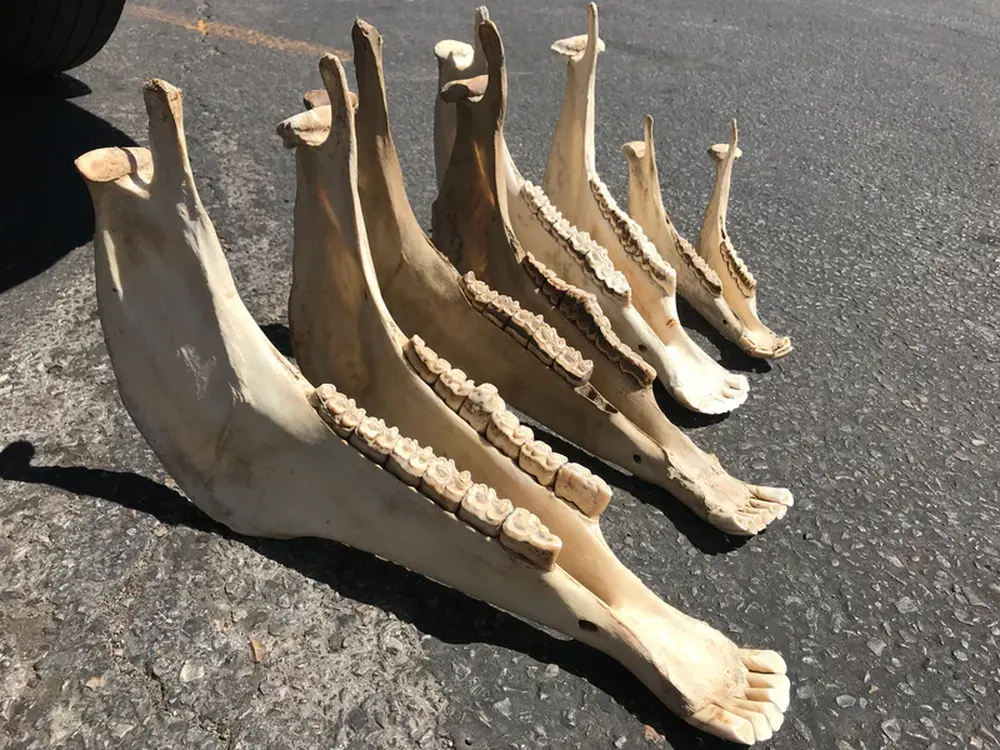
The late ethnomusicologist William Tompkins notes that a quijada can also be the lower jawbone of an mule or an ass, the latter preferred by some because it is lighter and more portable. But we’ll stick with the donkey version. Once removed from the animal, the jawbone has to be boiled in soapy water, all flesh scraped off of it, dried thoroughly and its teeth “loosened by soaking them with alcohol or industrial rum (ron de quemar).” That last step may need to be repeated to get the appropriate dental action.
Then, held by the chin in the left hand, and scraped with a sheep’s rib in the right, the jawbone’s molars vibrate with a unique timbre. Those rattling teeth add a buzzing luster to the bone-on-bone crack of the striker. There’s really nothing like it.
As Heidi Feldman notes, Peruvian festejo and son de los diablos performances were the traditional venues for the instrument. But it has also found its way into other Afro-Peruvian traditions, such as landó, ingá and Alcatraz. And today, all sorts of modern groups in Peru have adapted the quijada. .Witness Novalima. Recordings by Susana Baca, Eva Ayllón, Perú Negro, Coba, Andrés Prado and others showcase it well.
Details about the quijada’s deepest origins—almost surely Congo-Angolan—remain mysterious. It was first documented in Peru in 1773 in El Lazarillo de los Ciegos Camanantes (Guide for the Blind People) of Concolorcovo. There, it was observed in the hands of enslaved Blacks. In San Lazaro on 1810, it was part of the ensemble that greeted the “Queen of the Mandingos.”
Tomkins writes that essentially the same instrument has been documented from Cuba, Mexico, Ecuador and Brazil to the Carolinas and Louisiana. But those traditions seem to belong to the past. As far as we know, only in Peru has the instrument remained in popular use into the 21st century. The quijada’s earthy uniqueness works today as an affirmation Black identity and a central element in the thriving culture of Afro-Peruvian music and dance. That said, some who wish to project a more modern image, opt to use the vibroslap, which produces a similar effect. Similar. But as we say, there's nothing quite like the quijada!
Peru punches well above its weight when it comes to unique percussion instruments. There’s the cajita, a box that you open and close to create beats, and especially, the cajon, which has become a worldwide staple in ensembles from flamenco to funk. All that started in Afro-Peru. But the quijada has to take the prize for its singular appeal. The lowly donkey jaw heralded queens of old and and now propels the kings and queens of today’s Peruvian roots music.
Here are a few choice videos. You too can play quijada…if you can find a willing donkey.
Related Audio Programs