





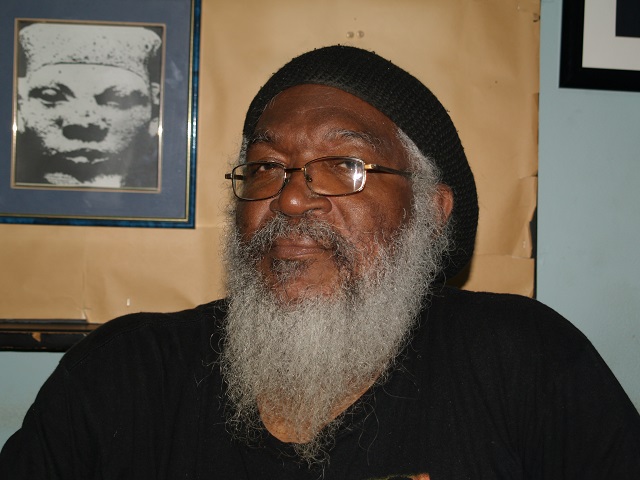
From an interview conducted by David Katz and Saxon Baird, Feb. 7, 2015. Photo©David Katz. Not to be reprinted without permission.
We’re trying to look at the relation between music and politics in Jamaica. Maybe you can start by talking about some things that happened before independence.
Dr. Clinton Hutton: Well, music has always been a very important political vehicle for the majority of Jamaicans. From the time of slavery and colonialism, African-Jamaicans have created music, have created lyrical contents that serve them politically, [with] music against enslavement and colonialism; music that helped them to cope with their enslavement; music that expressed the cosmological roots of African freedom as it developed in Jamaica from a philosophical standpoint; music that helped to entertain. But some of the most enduring ideas about freedom in Jamaica originated from, or certainly were expressed in Jamaican music, as African-Jamaicans developed those forms during slavery, especially music associated with funeral rituals. Wake songs, for example were songs essentially about freedom. They were songs centered around the spirit of the deceased going back to Africa. And, so, I actually coin those ideas, and the attendant music to those ideas, I term them “repatriational freedom songs,” because they were songs about going back to Africa.
In fact, that tradition did not stop with slavery and colonialism. It continued through independence and in the late '60s and in the '70s, especially, there were many songs about going back to Africa. That tradition is from 18th century Jamaica, and we’re talking about songs in Jamaican popular music such as the song by the Abyssinians, “Satta Amassa Ganna.” We’re talking about songs like Bunny Wailer, “This Train,” which is really a cover of an African-American spiritual, and African-American spirituals were replete with songs about going back to Africa because to Africans, freedom was derived from going back home. And, in the context in which they could not go back home physically, because they were not allowed to do so and because of the distance, the idea was that their spirit will go back home. And that is why funeral rituals were actually the most important rituals for enslaved Africans, not just in Jamaica but throughout the diaspora.
So, we have songs like “Got to Go Back Home” by Bob Andy, a late '60s song; we have a number of songs by Marley, “Exodus,” for example, is one of them. But you have songs that are related to those repatriational freedom songs about African redemption. Marley’s quite known for a lot of these songs, Peter Tosh, Culture, so that one cannot separate the issue of repatriational freedom from a broader knowledge, an embrace of Africa, and Africa as space, as a destination, for people who were enslaved and were desirous of going back home.
So there is an entire culture that has developed around going back to Africa. In songs, it is expressed a lot, but it is also expressed in the visual arts, including performance arts like jonkonnu, or more broadly speaking, the masquerade traditions in the Caribbean: rara in Haiti, Days of the Kings in Cuba, jonkonnu in Jamaica and in the Bahamas, and what they call mas for short in Trinidad and Tobago. So, there are many, many songs in the tradition of enslaved Africans about freedom and in particular about going back to Africa, and which, in the classical days of reggae music, when there was a shift in the politics in Jamaica…Michael Manley came to power and there was a shift in terms of the development of consciousness of the people. And certainly young singers and songwriters and musicians played a seminal role in denoting that shift in politics to a more anti-imperialist way of looking at things. And in fact, for rebuilding a nation, or to give birth to a nation that for over 400 years was the subject of Spanish, firstly, and secondly British, colonial occupation and enslavement of Africans.
It would be good for you to explain to the listeners about the rise of the Rastafari movement and perceptions of Rastafari in the wider Jamaica society.
The Rastafari movement emerged in Jamaica with the coronation of Ras Tafari, the Ethiopian regent, in 1930. Actually, Ras Tafari, or Emperor Haile Selassie the First, was declared a divinity by two traditional Jamaican religious entities: [there’s] a tradition in Revival called Poco [Pocomania], [which] actually declared His Majesty to be God Almighty. In fact, I have interviewed a Rastaman who came to Kingston in the 1940s, and he knew Marcus Garvey, Marcus Garvey went to his school in St. Elizabeth, one of our parishes in western Jamaica. So I asked him quite innocently, “At what time did you become a Rastafari?” He said to me, he became a Rastafari while he was in St. Elizabeth. I said, “No, but the history does not suggest that you would have become a Rastafari in St. Elizabeth, because there was no inkling, no strand of Rastafari in St. Elizabeth at that time in the 1940s. [And] he said to me that his Poco church, his traditional Jamaican spirituality, declared His Majesty to be God.
And then in St. Thomas, a similar thing happened with Kumina, the Kumina practitioners actually declared His Majesty the earthly manifester of Nzambi a Mpungu, the supreme god in the Congolese religious tradition that came to Jamaica in 1841, when Congolese where first brought here just a little after emancipation as indentured laborers, and which played a significant role in the justification and explanation for what Europeans call the Morant Bay Rebellion of 1865, led by Paul Bogle, but which the folk called the Morant Bay War. And in fact, there are a number of songs in Kumina today that are about that war. The Kumina tradition has actually carried over the narrative of what took place during that time into now. So that is one side of the creation.
Ras Tafari was the declared God by the traditional forms, but then some Garveyites, one of them was a leading figure somewhat in the Bedwardite movement of Alexander Bedward towards the end of the 19th century, and the first 20 years of the 20th century, his name was [Robert] Hinds, but Leonard Howell, who went away when he was about 16 [or] thereabouts, to the United States, he came back in 1933, declared His Majesty to be God Almighty and started to preach about him in Kingston. The first persons whose ear he caught in a big way were people from the Bedwardite tradition. Bedward actually died about six days after the first phase of the coronation of Haile Selassie; Haile Selassie was crowned, it’s a series of ceremonies, the first one was on Nov. 2, 1930, and Bedward died in the lunatic asylum in Kingston on Nov. 8—he was put there in 1921 by the British colonial authorities to silence him. In fact, Howell himself was put there as well, to silence him.
So, Howell came back a Garveyite, linked up with Robert Hinds, and the first audience to his preachings were members of Alexander Bedward’s congregation, but he met with much greater success in the parish of St. Thomas, that’s where the Morant Bay uprising took place, and which had a very strong tradition of African spirituality. And it was there that Howell preached all across the parish to hundreds of people, spied on by the police, arrested by the colonial authorities, tried for sedition. But that’s where Rastafari as an existential entity actually took root, and then the people who were closest to Howell, who found the core of his movement when he left or was driven out of St. Thomas by the colonial police—who also employed thugs to help them to do so—went from there to parish of St. Catherine, and bought a property called Pinnacle where a former British governor used to live in a Great House, John Peter Grant, who became the governor, incidentally, after the Morant Bay War, because Edward Eyre was sent back to Britain and he took over from Eyre and he lived at Pinnacle. Howell lived at Pinnacle and the core of his membership at Pinnacle were Kumina adherents, and it is responsible for really endowing in Ras Tafari some of his important identity features.
But Rastafari developed, not just at Pinnacle, but around what Rastafari called camps, and in the camps, what was constant was what they called “groundation,” reasoning with music, with the rituals of smoking the herb, or what they call the holy herb; I’m talking about ganja. And so, what actually emerged out of that, take, for example, the Rasta camp in east Kingston led by Oswald Williams, a man from St. Thomas known as Count Ossie. What grew out of his camp in terms of Jamaican popular music was the Skatalites: Don Drummond, Lloyd Knibb, Lloyd Brevett, Tommy McCook. All of these men were regularly situated at the camp in east Kingston—reasoning, playing music, their ritual of the holy herb—and which really was a space where the tone of the music that emerged in Jamaica—the way of playing the trombone, the way of playing the trumpet—was actually a transposition of the drumbeat. Count Ossie developed what is called the Nyahbinghi drumming tradition, which a young group of Rastafari in the late '40s, 1950s, appropriated in their chants. Count Ossie developed this because he was trained by an elder, a master drummer in the tradition of burru which came out of Clarendon regional music, a drumming form coming out of Clarendon and St. Catherine. And, in fact, it is part of masquerade tradition. And what Count Ossie did was to develop a pattern somewhat similar to burru, because it is coming out of burru, but also, fusing it with the Kumina tradition that he was familiar with in St. Thomas, but also which went with Leonard Howell to Pinnacle.
And so these Rastafarian camps were like a breath of fresh air in a space with a lot of colonial mentalities and consciousness. And out of that sprung the music of the Skatalites, which really combines, and textured, and remake, and covered, and sampled traditions outside of Jamaica; the Cuban tradition mambo, rumba, son, was very important to the Skatalites. I interviewed Knibb, for example, and he talked about that, but you can hear it in the music: “Latin Goes Ska,” it is from a popular Cuban [song] coming from Perez Prado. But they also did the same with songs coming out of the black experience, especially out of New Orleans. And they were into a lot of jazz because most of these musicians were trained especially, and mostly from Alpha Boys’ School, and they played in a number of big bands before they formed the Skatalites.