





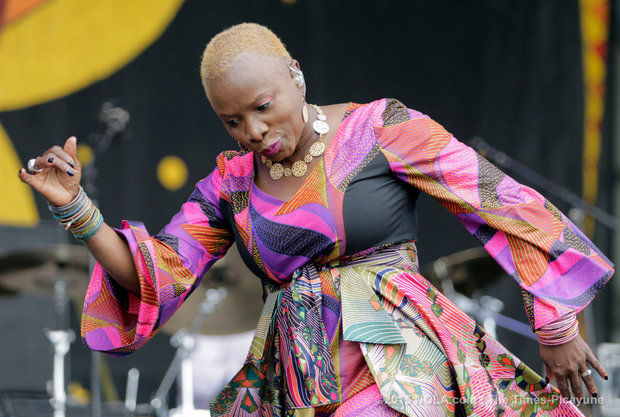
Midway through her electrifying, elevating set on the Congo Square Stage of the 2015 New Orleans Jazz and Heritage Festival, Angelique Kidjo introduced a song that she said was by the person who was her inspiration, whose very existence gave her the courage to become the artist she’s become—a singular figure of musical and cultural reach coming from her native Benin and now spanning the globe.
She was not going to tell us the name of the person, though, or of the song. If you didn’t already know that upon hearing it, “then you don’t live on this planet!”
Truth is, there were likely many in the crowd—a good number of them had set up at that stage area in anticipation of hip-hop/pop star Pitbull’s subsequent headlining set—who knew nothing of South African singer Miriam Makeba nor her groundbreaking international hit “Pata Pata.” Still, nearly everyone there was swept up by her unbridled energy, enthusiasm and pure joy in performing that effusive song. They danced with her, they sang with her, they smiled and laughed with her, and through Kidjo they now know Makeba’s spirit.
That’s what Kidjo does with, well, everything. She moves forward as if the world were how it ought to be, not how it is. And by her actions she helps make it so. And when she sees wrong in the world, she works hard, dedicatedly, to change it, with words, with action, and of course with music. It made for a clear highlight in days full of highlights in this seven-day festival-like-no-other—a day on which the Fairgrounds’ 10 stages hosted dozens of acts ranging from the astonishingly great teen ensemble of student "interns" from the famed Tipitina's club to the surprisingly engaged and powerful headlining set by the Who.
After she and her band opened with the voice-and-percussion chant “Ebile,” harking back to her childhood start with her mother’s traditional performance troupe in Cotonou, she introduced “Kulumbu,” from her recent world music Grammy Award-winning album Eve, with a powerfully concise condemnation of rape as the newest weapon of war and a call for women’s bodies and brains to be central to any peace process. The song itself is not dour, not condemning, but an exuberant celebration of women’s spirit, clear even to the vast majority of listeners who, presumably, do not understand a word of Yoruba. (Too bad New Orleans’ own Dr. John wasn’t on hand to add the piano solo he does on the album version.)