![]()
The Afropop team met with Youssou in Fes, Morocco, to discuss his newest project, Egypt (2004, Nonesuch): a collaboration with Egyptian master-musician Fathy Salama and an Egyptian orchestra. The following combines a brief interview with Youssou during rehearsal and a press conference with both Youssou and Fathy.
Youssou N'Dour: Good. It's not like the classic Youssou N'Dour, but people get the album and now they're starting to talk about it. I am very happy for the reception. People are okay with the words, they are behind every leader of brotherhood. People are proud, saying I'm right about the words, the story, the memory--I'm very happy. People often say "He's wrong!" But I'm happy that people say "you're right!" regarding what I say. They feel the music. They know this is not music for Thiosanne [Youssou's nightclub]. They know diversity--a word I've been talking about for ten years--diversity. I refuse to be going in just one direction. I have the possibility to touch different directions, and it's great for me.
Youssou N'Dour: Yeah…weeks ago we were in Paris with twenty thousand people to support us. It was the "Grand Bal"--the African ball.
Youssou N'Dour: Yeah, the place will definitely be different.
Youssou N'Dour: The right music for those people is this thing that I do. I've been talking about those people for a long time.
Youssou N'Dour: I think it's the middle.
Youssou N'Dour: This is a project that we've been waiting to see a live performance of and for it to be released for a long time. We've been working on this for five years now, mixing our traditions. We hope you like it.
Youssou N'Dour: Fes means a lot to us Senegalese; it's the base for Tijaniyya; in Senegal, we have the brotherhood of Tijaniyya. So the relationship between Fes and Senegal is very strong because it was through this brotherhood that Islam was brought to Senegal. Also, I think this festival is important because when you see something enduring for ten years here in Africa, you know it is something special. There are a lot of things that happen for two or three years and they don't finish. This time we can celebrate a tenth anniversary--it's a great thing and it's beautiful.
Youssou N'Dour: The project started in a very natural manner. Each month during Ramadan, I stop my activities. I stop my tours. I stay at home. Each time, I meet with friends to discuss our religion, our practices, and sometimes we have talks with more religious people than us. One day, I said to myself that since this period is really interesting, it would be good to have music that was in tune with it. At the same time, it reminded me that when I was ten years old, my father had a big radio on which he would listen to the music coming from North Africa, and I heard the voice of Umm Kulthum all the time. So the two ideas came to mind--Ramadan and the music coming from Egypt--and I met the former manager of Xalam. I saw him with some Egyptians and I spoke to him about my project and then he introduced me to Fathy Salama who I didn't know at the time. I listened to his music. I felt like this guy was like me. He we moving in Egpytian and international music. I called him and he came to Dakar to meet me. We started working, talking, and he made the arrangements of my musical ideas. After this stage, we recorded some instruments. What made the project interesting and a little difficult was that it's a personal album. No labels in Africa were informed about it. I didn't want the Senegalese percussionists involved to hear my voice. I lied and told them that it was Fathy's project. Meanwhile, we had modified my voice a little, and so they heard a voice that was slightly robotic and we told them that it was Fathy's. I really was trying to hide the project. It was finished by the end of 1999/beginning of 2000. By 2001 I had the project on me. When others heard it, they told me that I was crazy--that it wasn't just a personal project but something to be enjoyed by everyone. They tried hard to convince me. But I was also about to release "Nothing's in Vain." After September 11th, some friends suggested I push this Egypt project before "Nothing in Vain," but I refused. Now I'm happy with the project and that people are discovering and reacting to it. I'm not fixed in a style. I'm someone who thinks that music is freedom--passion and liberty. I go where I want to with the music. I think this astonishes a lot of people but there are other people who know my reputation to move with different musical styles. I'm happy this project was born. Fathy really helped me with this project both personally and professionally. We shared some extraordinary experiences in Dakar, discovering my club, the music, and Senegal in general. My dream is to play this music in Cairo and to share it with the Egyptian public.
Fathy Somehow we are reincarnating something that did once exist. If you look at how Islam came to Senegal, it came from Saudi Arabia through Egypt and eventually to Dakar. So we have a lot of connections originally. Also we should remember that the south of Egypt is black people. We have to remember that Egypt has different colors but we also have black people and black music. I myself was astonished because some of Youssou's tunes use really old, Arabic, Egyptian scales. While we were recording, a lot of the Egyptian musicians asked me if I had taught Youssou to sing in this style. What I'm trying to say is that the origins are the same, but it takes someone like Youssou to dig into his own tradition and come up with something like this. Going back to how this process happened, I have to first say that I've been a big fan of West African music, and more particularly Youssou, for a long time. And then when I went there, I fell in love with Senegal: the culture, the people, and the Senegalese view of Islam as well. We started this in Youssou's own home. I listened to the songs and then made some melodies and recorded them with a click track. Then I went back to Cairo to fill in the arrangements. First, I used some synthesizers to emulate the real sounds I wanted on the album. I sent a demo to Youssou and he liked it and said "go ahead." So I started recording. I should also say that there were lots of people involved in this recording--more than the people you see here. There were about fifty or sixty people from Cairo, covering almost every traditional instrument available and a whole orchestra of strings.
Then I went back to Senegal, and we added Senegalese instruments like kora, xalam, balafon. We wound up with a product…it was really lots of work. So, in my opinion, it's a reincarnation of what existed already.
Youssou N'Dour: I would like to credit Kabo Gueye for his help on shaping the material. He's also present in Fes today.
Youssou N'Dour: In the present international context, it's difficult to find a way to make people understand the meaning of our religion. The people in the West are ignorant of it. We have to find ways to put people at ease--to give people the context. Egypt is not just a country, it's a concept, it's a spirit. With this album, I wanted people to understand that there are not several Islams--one in Senegal and one in Egypt, etc-- but one. The ways of promoting Islam are different but the meaning is the same. In the past the relation between Egypt and Senegal was very strong. The wise people of Senegal talked and wrote a lot about Egypt. For me, it was evident that this name tied in well with the global context. The name "Allah" always existed and remains in the album. The title was also a way of paying homage to Egypt.
Youssou N'Dour: I really wanted it to be a surprise. It was a personal project. We come from an oral tradition where people speak a lot. I felt reluctant to sing things related to Islam. People in Senegal follow my movements closely. I was always afraid, based on what people say, what I heard, and what I saw, that we do not have out place in the religion to sing about Islam. I did not want to shock the people. People have a certain image of me, so I went slowly in the process. I was born Muslim and I practice it. And also I felt it something related to my intimacy and so I wanted to, in a way, keep it for myself. Fathy was living at my house and I introduced him to my friends as someone who was working in my studio on his own project.
Youssou N'Dour: We talk about lots of social things. She has a foundation called "Education and Health". I also have a foundation with my friends for the development of the youth. So, we talk a lot about mobilization efforts against malaria, research and solutions to help children, and things like that.
Youssou N'Dour: No. I have my opinions in regards to Senegalese politics, I live there and I see what happens every day. But, I am passionate about music. I'm much more useful with my music. Politics does not interest me--it's not my thing. It's not only in government that one can serve his country. I consider what I do to be service to the country. I give back to my country what it gave to me. I'm more useful being out of government.
Youssou N'Dour: This project did me some good personally. It made me closer to my religion, to my God. I learnt a lot about the guides of Islamic brotherhood. Music is a tool for Muslims to be better understood by the public. In each religion there are extremists. There are people that get a little too deep. So if I can express to people--even to one person--through my music that our religion is one of peace and love, of respecting others, of tolerance, than I am happy.
Youssou N'Dour: Yes, some years ago, I was shocked by people called Oustas who preached on the radio. A musician called on the program and asked if it was alright to make the pilgrimage to Mecca with the money he earned from his music. The answer was "no." I was shocked. There are such things that shock and cast fear and aren't true. Some people use religion to talk to the youth. And they transform them into extremists very quickly. Fortunately, they are in the minority, and they should stay in the minority.
Youssou N'Dour: My important message is that having no diversity is a very big problem. The difference between religions and languages is not an obstacle but a wealth.
Youssou N'Dour: I am a Mouride. Cheick Amadou Bamba was a leader of the Mourides who fought against the colonialists. The colonizers didn't want the past Islam to settle in our country. Amadou Bamba was deported. And when he came back he created the holy city of Touba. And the two messages from Mourides are: the word (or the message) and the second is work. This work is understood as something that pushes people to create. It's not just standard. In the 1960s and 1970s, power was in the hands of only a few people--a certain social class. But now the economy is more balanced, more widely shared. For example, you might see a big Mourides with a grand boubou in a Mercedes and a big sack of money to take to the bank. The work of the Mourides has helped a lot in having the country find a better balance within the classes and in the economy.
Youssou N'Dour: No, I can't say anything because it's not something that's happening right now. This time I'm not lying. It's true that there are a lot of projects that are around. But for now, I am totally immersed in my current album, Egypt. I think it can act as a big door for collaborations and I'm very happy about that. But for the moment, I don't have anything to tell you about projects that are being discussed or proposed.
Youssou N'Dour:Yes, thank you.
"July 9, 2004 Great African Ball"
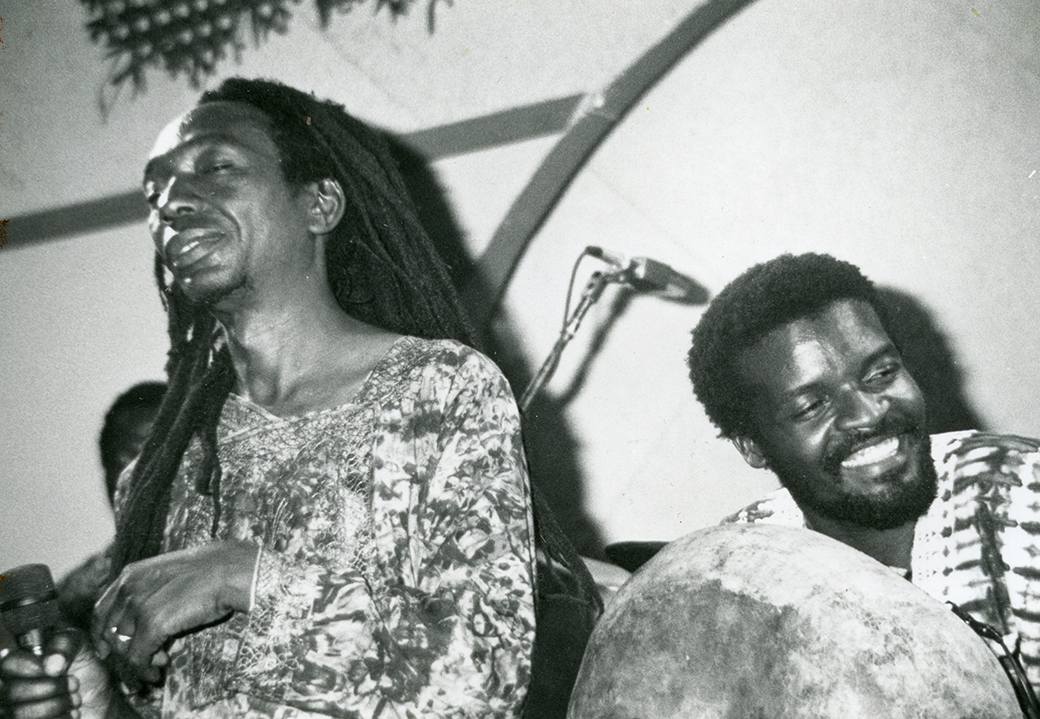
Youssou N'Dour in Morocco, May, 2004Interview by Banning Eyre and Sean Barlow Fes, Morocco,2004
|